

Brief Summary
Highlights of the Month
3.1 Global crude steel production declined
In March 2026, crude steel production from 69 reporting countries reached 159.9 million tonnes, a 4.2% decrease compared with March 2025. China’s 6.3% decline weighed on the global total, while countries such as India and Türkiye recorded growth.
3.2 Türkiye showed positive steel production growth
Türkiye produced 3.3 million tonnes of crude steel in March 2026, increasing by 6.4% year-on-year. In the January-March 2026 period, Türkiye’s total crude steel production reached 9.7 million tonnes.
3.3 CBAM and carbon reporting remained central to industry
With CBAM entering its definitive phase in 2026, product-level emissions verification became more critical for carbon-intensive sectors such as iron-steel and aluminium. For steelmakers, this is now not only an environmental issue but also a commercial and competitiveness requirement.
3.4 Nature Materials highlighted corrosion and advanced materials
March 2026 Nature Materials publications highlighted fracture behaviour in active solids, 5d-electron materials for future technologies, and anodic protection for moisture-stable Mg₃(Sb,Bi)₂ thermoelectrics. The Mg₃(Sb,Bi)₂ study is particularly relevant because it connects corrosion resistance with energy-efficient cooling applications.
New Developments in Metallurgy and Materials Technologies
Section 4
On the industrial side, the key March 2026 issue was the balance between production volume and carbon-related costs. While global steel production declined, Türkiye’s production growth provided a positive signal for the sector. However, demand fluctuations, energy costs, and CBAM compliance require producers to invest more in efficiency, scrap usage, electric arc furnace optimization, and emissions reporting.

Section 5
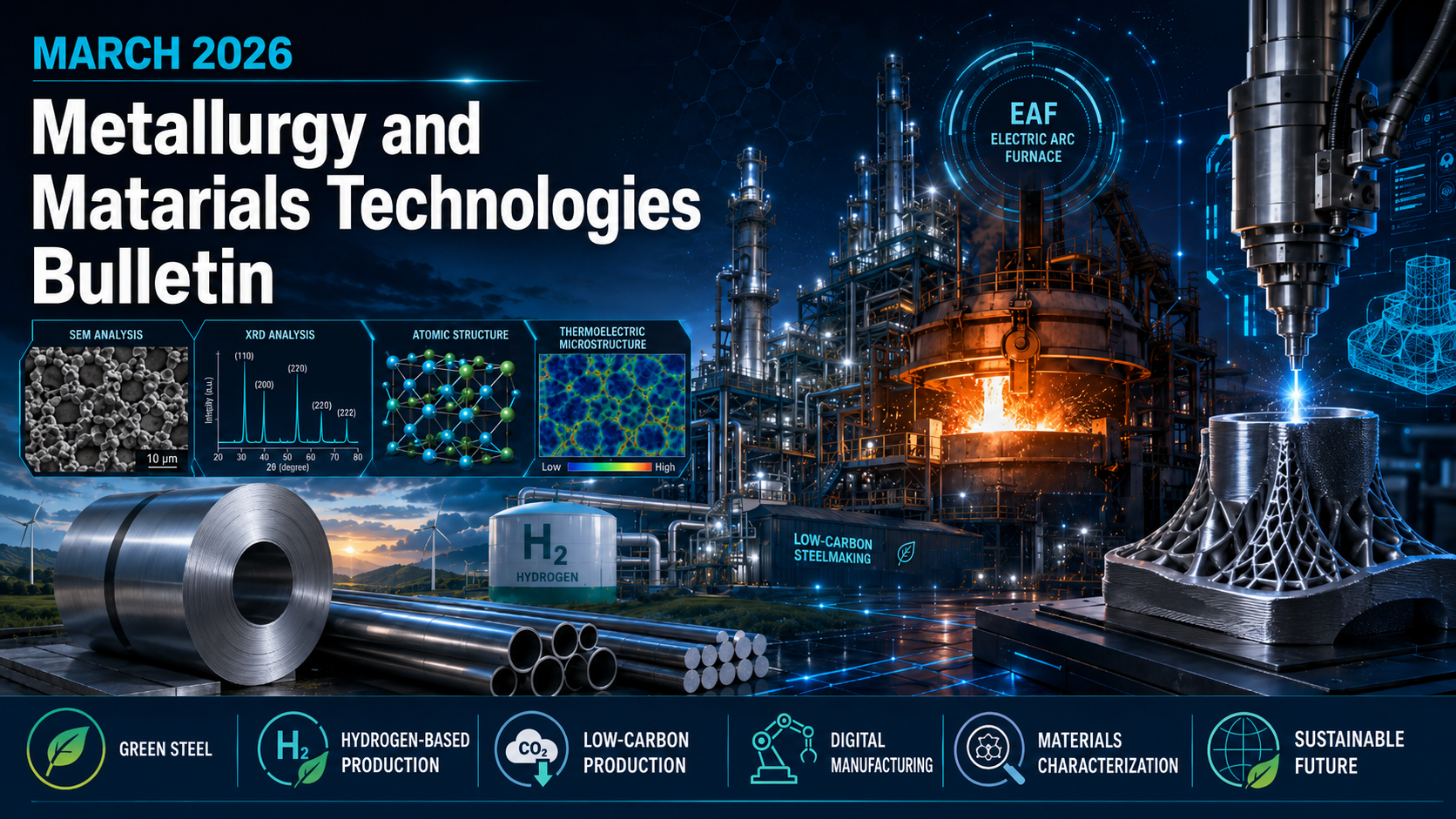
In March 2026, the sustainability and green metallurgy agenda focused on low-carbon steelmaking, hydrogen-based DRI, electric arc furnaces, scrap recycling, and product-level carbon footprint calculation. The decline in global steel production did not reduce the pressure for transformation; instead, it reinforced the need for better data, cleaner energy, and more efficient processes for low-carbon production and competitive exports.
Section 6
Three Nature Materials topics are particularly valuable for the March 2026 academic research agenda:
Fracture behaviour in active solids: The role of topological defects in fracture behaviour was discussed for active solids. This topic is important for advanced functional materials and failure analysis.
Materials with 5d electrons: 5d-electron materials were highlighted as an important research area for future electronics, energy, and quantum technologies due to their electronic structure and functional properties.
Corrosion resistance in Mg₃(Sb,Bi)₂ thermoelectrics: The anodic protection strategy for improving moisture stability in Mg₃(Sb,Bi)₂ shows how critical environmental durability is for energy materials.

References
March 2026 References
1 - World Steel Association – March 2026 crude steel production. Go to Source
2 - Turkish Steel Producers Association – March 2026 sector evaluation. Go to Source
3 - European Commission – CBAM. Go to Source
4 - Nature Materials – Physical sciences and materials research. Go to Source
5 - Nature Materials – Materials Science subject page. Go to Source
6 - Nature Materials – Focus Collections. Go to Source
7 - Nature Materials / PubMed – Moisture stability in Mg₃(Sb,Bi)₂ thermoelectrics. Go to Source
8 - IEEFA – Green steel technology transition. Go to Source